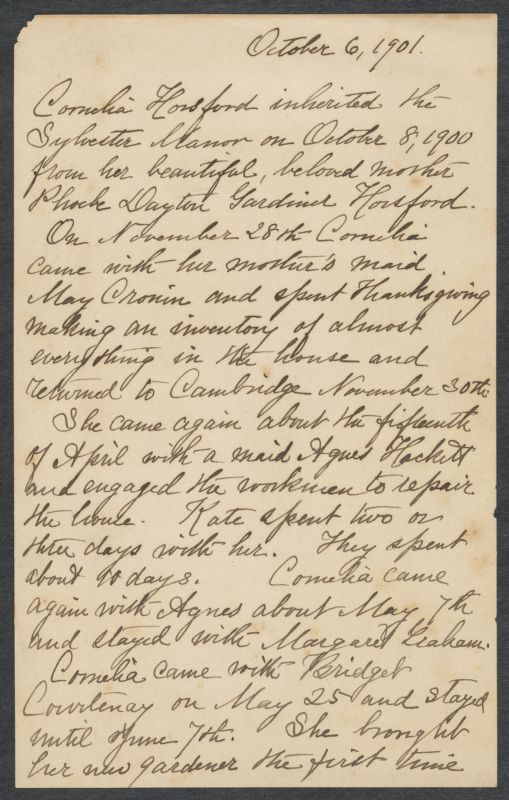
Cornelia Horsford's Activities at Sylvester Manor: 1900-1901
Laura
Upon first glance, one might think this document was not written by Cornelia due to its usage of the third-person: “Cornelia Horsford inherited Sylvester Manor.” However, based on the Sylvester Manor Archives’ wealth of letters, notes, and other documents written by Cornelia, we can deduce that these notes were indeed penned by Horsford herself. Her consistent practice of third-person journaling speaks to her attention to detail and her historical thinking. She documented her life in an unemotional and almost scientific manner. She doesn’t appear to have written these notes for herself, but for a greater historical narrative.
She wrote this note reflecting on her first year owning Sylvester Manor, just about a year after her “beautiful beloved mother” died, leaving her with the Sylvester estate as an unmarried 40-year-old woman. Due to a complicated family tree, she inherited the manor as the youngest of four other half-sisters. She came to be a single, property-owning woman at the beginning of the 20th century, a time when women did not yet even have the right to vote.
What does this record of her first year as the new owner of Sylvester Manor, reveal? Cornelia didn’t waste any time: she inventoried everything in the house in just two days and later made a whirlwind of aesthetic changes. She poured herself into the domestic and aesthetic fabric of the home and remembered each small detail a year out from the work: landscape, wallpaper, gold plush sofas, higher ceilings, and new cutlery sets.
It is worth noting the extent to which she relied on the support of hired domestic labor, situating her unique position as an upper-class, property-owning white woman. The first person she brought to the manor after inheriting it was her mother’s maid, Mary Cronin. She named a cast of characters behind the labor of the Manor’s re-decoration and renovation: maids, multiple gardeners, and a mysterious “Mack” who laid out both the garden and the rose terrace.
It is also worth noting the contrast between Julia and Cornelia’s trajectories in relation to property ownership. Cornelia’s inheritance of a vast estate and luxurious manor is juxtaposed with the previous document we see in this series, a deed of sale, where Julia sold the little land she had to Cornelia’s grandfather, Samuel Gardiner, for $160. In fact, the land that Cornelia inherited in 1901 would have included that tract Julia sold back in 1836.